Governing Autonomous Agents Is a Platform Problem
TL;DR
If agents are actors with delegated authority, then governance is not a compliance layer. It is architecture.
I’ve been thinking about this a lot lately.
In earlier posts I argued that agentic AI forces a platform mindset. Then I argued that agents are not software. They behave more like participants inside your system than code you ship.
If that’s true, then deployment stops being the main event. Governance becomes the main event.
Agents Change the Failure Model
When I first started building agent systems, I caught myself asking the wrong question: “How do we deploy this safely?”
The honest answer is, that’s not the hard part.
McKinsey defines agentic AI as systems that can execute multistep processes and act in the real world, not just generate text. That shift matters.
The moment your system can:
- Call tools
- Modify state
- Chain decisions
- Retry autonomously
- Run asynchronously
- Interpret feedback
…it is no longer just producing output. It is producing impact.
Research on LLM-based autonomous agents consistently breaks them into memory, planning, and action modules.
That framing resonated with me because it matches what we see in practice.
Once action enters the loop, governance cannot be a release gate. It has to be continuous supervision.

This Is Showing Up in the Market
You can spot this pattern pretty quickly.
Gartner projects that more than 40 percent of agentic AI projects will be canceled by 2027 due to cost and unclear value, even while predicting heavy enterprise penetration. The core issue is the operating model, not model quality.
Microsoft has been building agent identity and governance into its platform since Build 2025, and later introduced a control plane that can track, measure ROI for, and even quarantine AI agents. When vendors start talking about quarantine, you are not in deployment land anymore. You are in governance land.
Governance Is Lifecycle Work
This is not just vendor positioning.
NIST’s AI Risk Management Framework makes it explicit: governance applies across the entire lifecycle, not just at deployment.
The AI RMF Playbook calls for:
- Clear responsibility chains
- Monitoring and audit frequency
- Integration with enterprise risk controls
- Formal change management
NIST also highlights how AI risks differ from traditional software risks: drift, opacity, emergent behavior, and difficulty knowing what to test. That line stuck with me. If you don’t know what to test, you can’t rely on static gates. You need living governance.
The EU AI Act reinforces this with explicit requirements for human oversight and post-market monitoring for high-risk systems. This is supervision over time. Not a checklist.
Governance as Code
Here’s what was bothering me for months.
Most organizations have AI policies. Very few have AI policies that survive a Git push.
Governance as code means:
- Policy is machine readable
- Version controlled
- Testable
- Enforced at runtime
Open Policy Agent is one of the clearest examples of policy as code in practice. Upsun summarized the problem well: policies in PDFs do not scale.
If you are at startup scale, you might gate autonomy through manual approvals. If you are in the enterprise, that breaks immediately. The sweet spot is programmable delegation. Explicit authority boundaries. Escalation rules in policy. Blast radius encoded, not assumed. That is governance as code.
Preventative and Detective Controls
Autonomy needs both.
Preventative
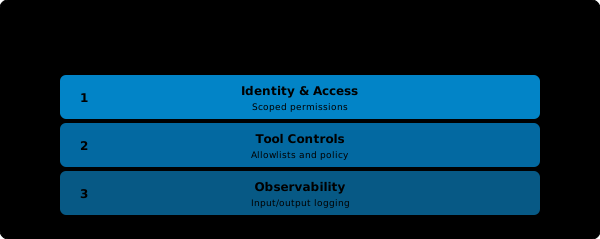
SailPoint frames agents as governed digital workers whose access must be explicitly bounded by identity and time. That maps cleanly to what we see in real systems:
- Scoped delegation
- Time-bound credentials
- Tool allowlists
- Budget ceilings
- Approval gates
OWASP’s Top 10 for LLM Applications adds another layer: prompt injection and insecure plugin design become materially worse when the system can execute tool calls. Preventative controls define what an agent may do.
Detective
Detective controls define what happens when autonomy drifts. NIST’s Generative AI Profile recommends continuous monitoring of outcomes, anomaly detection, and post-deployment evaluation. The EU AI Act requires deployers to monitor operation and intervene when risk emerges.
The hard part is not setting boundaries. The hard part is knowing when autonomy crosses them. Can you reconstruct the action chain? Can you attribute authority? Can you quarantine safely? If you can’t, you don’t have governance. You have hope.
Evaluation Is Governance Discipline
I’ve become convinced that evaluation is not just model testing. It is governance discipline.
NIST’s TEVV framework treats testing, evaluation, verification, and validation as lifecycle work, including operational phase monitoring and incident tracking. That breaks down into two layers:
Build-time evals
- Scenario testing
- Policy adherence checks
- Red teaming
- Tool sequence validation
Runtime evals
- Drift detection
- Incident tracking
- Escalation rate analysis
- Emergent behavior monitoring
The UK AI Safety Institute’s Inspect framework shows how evaluation can even be embedded into agent tool loops directly. If governance is code, evals are the test suite. Without them, policy degrades silently.
The Pilot to Production Gap
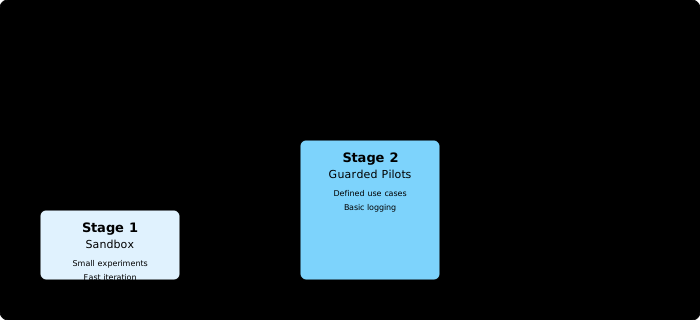
The MIT NANDA “GenAI Divide” report shows how many organizations evaluate generative AI tools, but very few reach sustained production use. Gartner’s 40 percent cancellation projection reinforces this.
The gap is supervision. IBM’s governance guidance emphasizes defined roles and reporting lines across the AI lifecycle. That matches what I’ve seen firsthand. If no one owns delegated authority, autonomy stalls. Or worse, it scales without supervision.
The Real Shift
In earlier posts I argued that agents are not software. This is the continuation.
If agents are actors:
- Authority must be explicit
- Oversight must be continuous
- Evaluation must be embedded
- Revocation must be possible
These are operating model principles — platform design, not individual features.
Next Steps
If you are experimenting with agents today:
- Map authority boundaries explicitly, who delegated what, for how long.
- Encode those boundaries as policy, not documentation.
- Add build-time policy tests before autonomy expands.
- Add runtime monitoring that can reconstruct action chains.
- Assign named owners for agent supervision, not just system uptime.
Autonomy scales fast. Supervision must scale faster. If you don’t design governance into the platform, you will retrofit it under pressure later. I’ve seen that movie before.