From Periodic Reviews to Continuous Governance
A few days ago I wrote that governing autonomous agents is a platform problem. The core argument was simple: if agents are actors with delegated authority inside our systems, governance cannot live purely in documentation or review processes. It becomes part of the architecture itself.
The conversations that followed moved in the same direction. Not whether governance should be embedded into the platform, but what that actually looks like in practice.
AI governance is starting to look a lot like engineering infrastructure.
The Governance Problem Most Organizations Are Running Into
Most enterprises still approach AI governance with a structure that looks roughly like this:
- Document the intended use of the model
- Run validation checks before deployment
- Submit artifacts for review
- Monitor occasionally after launch
That model worked reasonably well for earlier machine learning systems. Traditional models were relatively static. They were trained, validated, deployed, and then monitored periodically.
Modern AI systems are different. Behavior changes with prompts, context, retrieved data, tool outputs, and system interactions. Agent systems add more complexity because they can plan actions, call tools, and modify system state.
Exhaustive pre-deployment testing is not possible. Governance cannot rely on static checkpoints anymore. It has to operate continuously.
The Shift from Review Cycles to Continuous Governance
The most important shift I keep seeing is this: governance is moving from periodic review to continuous operational control.
Instead of asking “Was this system compliant when it launched?” organizations increasingly need to ask “Is this system behaving safely right now?”
Once you start thinking this way, governance stops being a documentation process and starts becoming a runtime capability.

In practice, the architectures emerging across many organizations tend to converge around four capabilities:
- Evaluation systems that continuously test model and agent behavior
- Runtime controls that enforce policy while the system is operating
- Observability pipelines that capture traces and safety signals
- Evidence generation that produces audit artifacts automatically
Not because governance frameworks require it, but because operating AI systems at scale eventually forces it.
Evaluation Becomes Part of the Software Lifecycle
Evaluation used to be thought of primarily as model testing. Increasingly it is becoming a governance discipline.
Evaluation pipelines now run continuously during development and deployment. They test things like:
- adversarial prompts and jailbreak attempts
- bias and fairness metrics
- regression behavior when models or prompts change
- correctness of agent tool invocation
If governance policies are machine-readable, evaluation becomes the test suite that enforces them. Without continuous evaluation, governance quietly degrades every time a model, prompt, or tool changes.
Runtime Controls Become Necessary
Evaluation alone is not enough. Agents operate in environments that change constantly. Context shifts, retrieved data changes, and tool outputs introduce behaviors that pre-deployment testing cannot fully anticipate.
This is where runtime governance becomes essential. Emerging platform architectures introduce controls such as:
- Input guardrails that detect prompt injection or unsafe requests
- Policy engines that enforce authorization when agents invoke tools
- Kill switches that halt systems when risk thresholds are breached
- Human-in-the-loop escalation for high-risk decisions or outputs
These mechanisms keep governance operational while the system is running, not just before it is deployed.
Observability Becomes Governance Telemetry
Observability is more central to governance than it might first appear. You cannot govern what you cannot reconstruct.
If an agent takes an action, you need to know:
- what prompt triggered the decision
- which tools were invoked
- which identity authorized the action
- what context influenced the outcome
That requires full traceability. In practice: inference traces, agent decision chains, guardrail triggers, evaluation scores, and drift signals across the system lifecycle.
At that point governance looks less like compliance reporting and more like operational telemetry.
Evidence Becomes a By-Product of the System
In traditional governance models, teams assemble documentation packages manually for audits or regulatory reviews.
In continuous governance models, those artifacts become a natural output of the system itself. Evaluation reports, guardrail events, decision traces, and risk dashboards are generated automatically. The evidence exists because the system produced it while operating, not because someone prepared it before a meeting.
Thinking in Terms of Risk Surfaces
A useful way to understand why this architecture emerges is to think in terms of risk surfaces. AI systems introduce risks across several layers simultaneously:
- data and knowledge sources
- model behavior
- prompts and context
- tools and actions
- identity and access control
- observability and auditability
- operational resilience
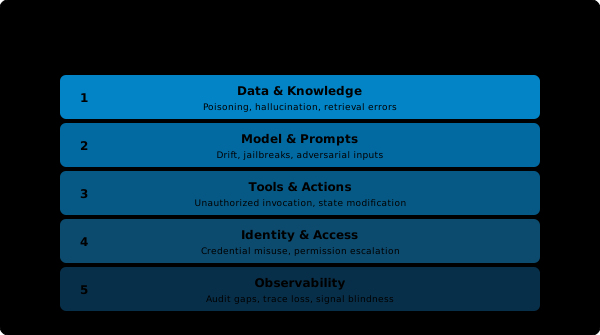
Traditional governance models often focus on one layer at a time. Continuous governance works because it instruments each of these surfaces simultaneously.
The Deeper Shift
For years, governance in technology was largely procedural. AI is pushing it toward infrastructure.
Policies still matter. Risk frameworks still matter. But the organizations that will scale AI safely are the ones that embed controls directly into their platforms. If agents are actors inside our systems, governance becomes the control plane that supervises them.
And like most control planes, it has to run continuously. The teams building it that way now will not notice it is there. Everyone else will.