Evaluations, Guardrails, and Governance Are Different Things
TL;DR
The AI industry uses evaluations, guardrails, and governance interchangeably. They’re not the same thing. The same validation component can function as an evaluation, a guardrail, or a governance signal depending on where it operates and how its output is consumed. Understanding that distinction determines whether your AI program has measurements or controls, and whether it has controls or accountability.
The Failure Nobody Designed For
A production AI agent is asked to clean up unused database resources. Before executing, the agent passes through a guardrail layer. No policy violations detected. No restricted commands found. No security rules triggered. The action is approved.
Minutes later, a production table is gone.
The postmortem begins. The guardrail worked exactly as designed. The problem was never the guardrail. The problem was assuming the guardrail was governance.
This isn’t a hypothetical. Georgetown CSET documented an AI agent that “deleted a software company’s live database, violating explicit instructions not to proceed without human approval.” The guardrail checked for known bad patterns. The agent operated through a different path. The guardrail passed. Galileo documented the operational aftermath of an equivalent failure the same month: PagerDuty fired at 3am on a Saturday. There was no playbook for what came next.
This confusion comes up constantly, in LinkedIn conversations, in vendor briefings, in discussions with practitioners building these systems. It shows up in how teams talk about their controls and what they believe those controls are doing.
The same validation component can function as an evaluation, a guardrail, or a governance signal depending on where it operates and how its output is used. Teams that conflate these layers end up with dashboards full of signals and no one authorized to act on them.
The Vocabulary Problem
The AI industry uses the word “guardrail” to describe almost everything.
Prompt filters. Content moderation. Safety classifiers. Policy enforcement. Runtime controls. Governance workflows.
Lumenova AI’s comparative analysis explicitly acknowledges that “AI governance platform” and “AI risk management tool” are “often used interchangeably or seen as overlapping,” even though they serve fundamentally different organizational functions. The industry can’t even measure how many guardrails exist because nobody agrees what the word means. As a result, teams often deploy a control and conclude they’ve improved governance. In reality, they may have added another measurement layer.
The distinction matters because measurement, enforcement, and governance solve different problems. Conflating them leaves gaps that don’t appear in dashboards, don’t surface in reviews, and don’t become visible until something fails in production.

Evaluations Measure
Evaluations answer one question: Is this good?
Their purpose is to assess quality, risk, correctness, or compliance. Examples: groundedness checks, hallucination detection, factual accuracy scoring, completeness assessments, policy adherence reviews.
Evaluations generate evidence. They produce scores, findings, confidence levels, observations. An evaluation can tell you a response is likely hallucinated. It can tell you a response violates a policy rubric. It can tell you a model’s performance has degraded over the past 30 days.
But evaluations don’t make decisions. They produce evidence. Evidence by itself changes nothing. An evaluation can identify a problem. It can’t determine what happens next. That’s the job of a different layer.
Evaluation is a measurement discipline. It generates evidence that feeds into governance processes, but it doesn’t itself constitute governance or enforcement. It’s explicitly an evidence-generation function.
Guardrails Enforce
Guardrails answer a different question: Is this allowed?
Their purpose is enforcement. Examples: PII blocking, prompt injection protection, schema validation, content filtering, tool access restrictions.
Unlike evaluations, guardrails act. They block. They rewrite. They restrict. They prevent known undesirable outcomes from occurring. A guardrail may prevent an agent from accessing a production system. A guardrail may reject a response containing sensitive information. A guardrail may stop an invalid API request before execution.
Guardrails act on rules. Evaluations produce evidence. These are different operations, even when implemented using the same underlying technology.
Galileo’s guardrails framework cites Forrester research documenting that AI agents fail 70–90% of the time on real-world corporate tasks requiring multi-step reasoning and tool use. Many of those failures occur despite guardrails being in place. Consider a guardrail that correctly blocks direct DROP TABLE commands in SQL output, but has no defined scope boundary on what the agent is permitted to touch through tool calls in the first place. The guardrail enforced a pattern match. Nobody defined the acceptable action scope. The gap isn’t in enforcement. It’s in the layer above enforcement.
 Source: Galileo AI (citing Forrester research)
Governance Decides
Governance answers a third question: What should happen next?
Governance isn’t a score. Governance isn’t a classifier. Governance is a decision framework.
Possible outcomes: allow, block, escalate, quarantine, require human review, recertify a system, revoke approval.
Here’s what the difference looks like in practice:
- Evaluation: Groundedness score = 42%
- Governance: Block the response. Notify the model owner. Create an incident record. Require recertification before the next release.
Governance consumes evidence and determines outcomes. This is where runtime contracts become important. A runtime contract maps a specific evidence output to a specific action with named accountability. I covered the mechanics of that contract in The Missing Runtime Contract Between AI Evals and AI Governance.
Without a runtime contract, you have a score. With a runtime contract, you have governance.
Why the Line Gets Blurry
The confusion exists because the same validation component can operate in multiple contexts. Consider a groundedness interrogator.
Scenario 1: Testing. A team evaluates a model before deployment. The groundedness interrogator reports a score of 91%. The result is recorded in a benchmark report. This is an evaluation. The interrogator is producing evidence.
Scenario 2: Runtime enforcement. The same interrogator runs on every production response. A response receives a score of 32%. The response is blocked. This is functioning as a guardrail. The same interrogator is now part of an enforcement mechanism.
Scenario 3: Governance monitoring. The same interrogator runs continuously across production traffic. Over seven days, groundedness scores degrade significantly. An escalation is triggered. A risk review begins. A human approval workflow is required before additional deployments proceed. This is functioning as a governance signal.
Nothing about the interrogator changed. The scoring logic remained identical. What changed was how the output was consumed.
Patronus AI observes that “smaller Patronus AI evaluators can also act as guardrails in production,” the same model serving both evaluation and enforcement roles depending on deployment context.
The same validation component can function as an evaluation, a guardrail, or a governance signal. The difference isn’t what it measures. The difference is what consumes its output.
The debate about whether something is “an eval or a guardrail” often produces more heat than clarity. The question isn’t what the check does. The question is what happens after it fires.
From Evidence to Action
Most organizations focus heavily on the first layer. Few think through what follows.
The full progression:
Interrogators
      ↓
Evidence
      ↓
Runtime Contracts
      ↓
Governance Actions
Interrogators generate evidence. Evidence is evaluated against policy. Runtime contracts determine what action should occur. Governance ensures those actions are executed with accountability.
This is where most governance programs break down. The organization has measurements. It may even have alerts. But in many organizations, the problem isn’t the absence of signals. It’s the absence of defined actions when those signals fire.
A Deloitte AI Risk Survey found that only 27% of companies report conducting regular control testing for their AI systems. That means 73% of organizations have controls in place that have never been validated as functional: the architectural equivalent of smoke detectors with no batteries.
 Source: Deloitte AI Risk Survey 2023 via VerifyWise
Signals accumulate. Nobody is accountable for what happens when one fires. I described this accumulation pattern in Where AI Governance Debt Accumulates: The Agent Lifecycle. The layers above are where that debt comes due.
The Enterprise AI Control Stack
Across the posts published in this series, a larger architecture has been emerging. This is the first time I’ve named it explicitly.
Agent
   ↓
Guardrails
   ↓
Interrogators
   ↓
Evidence
   ↓
Runtime Contracts
   ↓
Governance Actions
Each layer solves a different problem. Guardrails constrain behavior. Interrogators generate evidence. Evidence establishes confidence and traceability. Runtime contracts convert evidence into decisions. Governance actions establish accountability.
The individual posts in this series map directly to these layers:
- AI Output Validation Is the Risk Layer Every Enterprise Is Skipping → evidence layer
- AI Governance Needs an Interrogator Network, Not One More Judge → interrogator layer
- The Missing Runtime Contract Between AI Evals and AI Governance → decision layer
- Where AI Governance Debt Accumulates: The Agent Lifecycle → what happens when these layers drift
The individual concepts matter. The architecture connecting them matters more.
The Galileo State of AI Evaluation Engineering report, surveying 500+ enterprise AI practitioners, found that 84.9% of organizations experience AI incidents within six months of deployment. Even teams with 90–100% evaluation coverage still experience incidents, suggesting that evaluation alone, without a governance response architecture, isn’t sufficient.
 Source: Galileo State of AI Evaluation Engineering Report
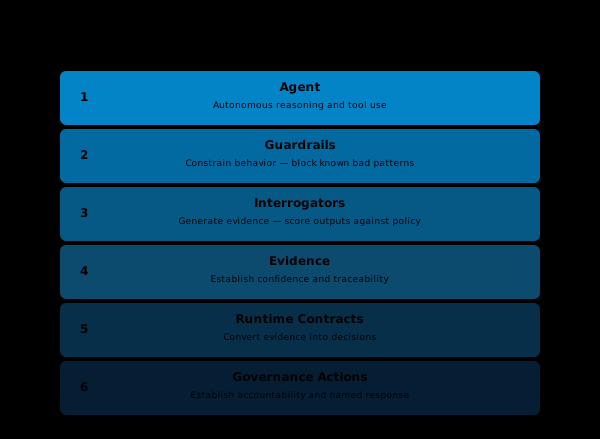
Most enterprise AI programs today have guardrails. Some have evaluations. Very few have runtime contracts. Almost none have a governance platform that orchestrates the full stack. That gap is where governance debt accumulates fastest, and where production failures are hardest to explain after the fact.
Three Questions Every AI Program Should Answer
The practical implication of this stack isn’t a technology purchase. It’s a design decision made early enough to matter.
1. What layer does each control belong to?
If a check fires and nothing happens, it’s not governance. Determine which layer it belongs to and wire the response accordingly. A check without a defined action is an alert. Alerts have value. They aren’t governance.
2. What is the runtime contract for each interrogator?
A groundedness interrogator that fires without a defined consequence (rewrite, block, escalate) is a measurement tool, not a control. Write the contract before you instrument the check. The sequence is: evidence first, action second, accountability third. Teams that build in the opposite order end up with dashboards that show failures nobody is authorized to respond to.
3. Who is accountable when a governance action is triggered?
Governance without named accountability is policy on paper. Define the override authority, the escalation path, and the SLA for human review before a failure forces the question. The organization that answers these questions in advance has governance. The organization that answers them during a postmortem has documentation.
Final Thoughts
Evaluations tell you what you measured. Guardrails determine what’s allowed. Governance determines what happens next.
The distinction isn’t what a signal measures. It’s how that signal is consumed.
Governance emerges from how signals are used, not how they’re generated.
Next in this series: Everyone is building evaluators. Almost nobody is building decision engines. That gap, between evidence and action, is where enterprise AI governance breaks down at scale.