Agent Observability: The Missing Layer in Agentic AI Platforms
TL;DR
Once agents can act, the ability to see what they’re doing becomes infrastructure, not a nice-to-have. Traditional application monitoring was designed for deterministic systems. Agent systems behave differently. Debugging, auditing, and governing agents requires new telemetry primitives built around trajectories, not just outputs. Without this layer, production agent systems become very difficult to trust, operate, or explain.
There is something quietly disorienting about watching a capable agent system deployed into production with minimal observability. The agent is doing real work, invoking real systems, producing real outcomes. And yet if you ask what exactly it did and why, the honest answer is often: we can see the result, but we cannot fully reconstruct the path.
That asymmetry between capability and visibility is a foundational problem. And I think we’re only beginning to understand how far it reaches into governance, trust, and operating model design.
When the System Can Act, You Need to Be Able to See
There is a pattern I keep noticing as teams move agent systems from prototype toward production. The initial investment is almost entirely in capability. Can the agent complete the task? Does it use the right tools? Is the model producing reasonable outputs?
Those are fair questions to start with. But they’re not the questions that tend to surface six months in.
What I hear more often now is something closer to: we deployed this agent, something went wrong, and we can’t figure out exactly what happened. Not because the system crashed. Not because there was an error log to point to.
But because the agent made a series of decisions, invoked a sequence of tools, and produced an outcome that nobody can fully reconstruct.
That gap between what the agent did and what we can see it did is where the next set of hard problems lives.
What Traditional Observability Was Built For
Logs, metrics, and traces have served us well for a long time. They were designed around a specific assumption: software is deterministic. Given the same input, it produces the same output. The path through the code is knowable in advance. When something fails, you find the exception, trace the stack, check the service that returned an error.
That model isn’t wrong. It’s just incomplete once agents enter the picture.
Agent systems don’t follow fixed execution paths. They reason. They decide. They chain steps together based on intermediate results. They invoke tools, pass context between components, sometimes delegate to other agents, and update their working assumptions as they go.
The path through an agent workflow isn’t predetermined. It emerges at runtime.
This changes what observability actually needs to capture. When a traditional service fails, you’re usually looking for what broke. When an agent system produces a bad outcome, you may be looking for why the agent made the choices it made along the way. That’s a meaningfully different question, and current monitoring tools weren’t designed to answer it.

One concrete failure mode worth naming: an agent can return a fluent, well-formed response while the underlying workflow produced an incorrect or incomplete result. From an APM perspective, everything looks green. No exceptions, no error rates, no latency spikes. The system appears healthy while something consequential has gone wrong.
Monte Carlo’s agent trajectory analysis describes this as the core observability challenge: behavioral failures in agents don’t necessarily produce errors, which means symptom-based monitoring is structurally insufficient.
 Source: Logz.io 2024 Observability Pulse Report
The Trajectory Problem
Think about what actually needs to be reconstructable when something goes wrong with an agent.
Imagine an agent tasked with processing a request that involves reading from a data source, making a judgment call about what action to take, and invoking a downstream tool to carry it out. Somewhere in that sequence, it invokes the wrong tool, or invokes the right tool with the wrong parameters, or makes a judgment call that doesn’t hold up under review.
To understand what happened, you need more than the final output. You need to see the prompt that shaped the agent’s reasoning at that step. You need to see which tools were available, which one was chosen, and what arguments were passed.
You need to see how context evolved through the chain. You need to see whether any intermediate steps produced signals that the agent factored in or ignored.
This is what I mean by trajectory. Not a log of what the system processed. A reconstruction of how the agent moved through a decision space. Objectways defines an agent trajectory as a step-by-step record of what the agent sees, thinks, and does: state, action, observation, reasoning, and outcome at each step. None of those map to traditional APM signals like latency or error rate.
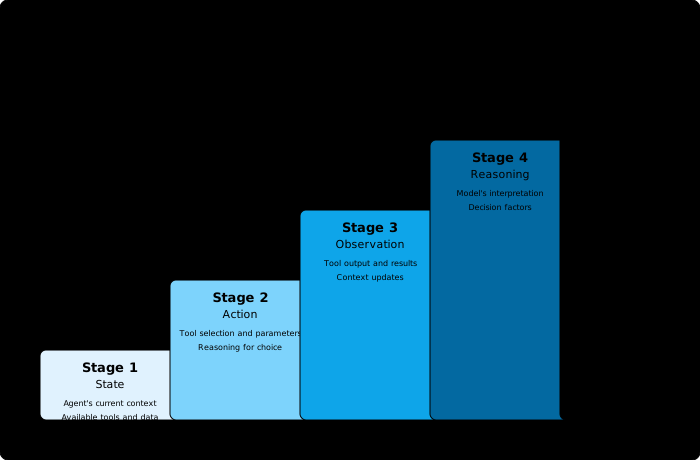
Traditional APM wasn’t built to capture this. It was built to capture events in deterministic flows. What agents produce is closer to an execution graph where the edges are decisions and the nodes include reasoning states. Capturing that requires something different.
The failure implications compound quickly. Vellum AI’s production analysis illustrates the math: an agent with ten steps running at 97% accuracy per step produces correct end-to-end results only 72% of the time. Outcome-only evaluation would show each step passing while the system is failing nearly a third of runs.
You can’t find that problem without trajectory-level visibility.
 Source: Vellum AI analysis of agent behavior in production
Where Governance Enters
I want to be direct about this because I think it gets underweighted in engineering conversations.
Observability for agents isn’t only an operational concern. It’s a governance and audit requirement.
In regulated environments, you can’t simply say an agent acted on behalf of a user and move on. You need to be able to answer: what did the agent attempt to do, what systems did it access, under whose delegated authority did it operate, and what constraints were active at the time?
Security teams will ask these questions. Compliance functions will ask them. And when something goes wrong at meaningful scale, the business will ask them.
This is where agent observability starts to intersect with everything else in the platform. Identity tells you who authorized the agent to act. Policy enforcement tells you what constraints were applied. Observability tells you what actually happened within those constraints.
The combination of those three things is what makes an agent action auditable in any real sense.

Without observability, identity and policy become claims rather than evidence. You can say the controls were in place. You can’t demonstrate what they produced at runtime.
Lasso Security’s LLM compliance framework identifies audit logging and evidence management as non-negotiable components of LLM compliance, noting that the EU AI Act requires high-risk systems to provide verifiable logs and documentation on training and inference data. In financial services and other regulated sectors, this is a legal requirement for systems operating in scope.
I’ve written about the governance layer more directly in Governing Autonomous Agents Is a Platform Problem. Observability is the layer that makes everything else in that argument operational.
New Primitives the Platform Will Need
I don’t think this problem is fully solved yet. But the direction is becoming clearer.
What agent platforms will likely need are telemetry primitives built specifically for agentic behavior:
- Agent traces that capture the full execution path of an agent workflow, including reasoning steps, tool invocations, context updates, and delegation handoffs
- Action graphs that make it possible to see which tools were called, in what order, and with what results
- Decision histories that capture why the agent moved in a particular direction at a branching point
- Interaction logs that record what the agent communicated to users or other systems throughout a session
Some of this overlaps with what distributed tracing gave us when microservices became common. Before distributed tracing, teams had the same kind of problem: requests would traverse multiple services and something would fail in a way that was very hard to pinpoint from any single service log.
Distributed tracing gave us the ability to follow a request across service boundaries and reconstruct the path it took.
Agent systems need something analogous. Not just traces that follow requests across network boundaries, but traces that follow reasoning across decision boundaries. Maxim AI’s framing of agent tracing maps this directly: each agent interaction generates a hierarchical record of all operations performed, from input processing through output generation, with nested spans for tool invocations, context retrievals, and model calls.
The underlying need is similar to distributed tracing even if the implementation looks different.
OpenTelemetry’s GenAI observability project is working on semantic conventions specifically for agent behavior. The standards are still emerging, which is worth noting honestly. The field is converging directionally, but this isn’t settled infrastructure yet.
Observability as the Foundation for Evaluation
Some teams have started investing in agent evaluation frameworks, which is the right instinct. Being able to assess whether an agent’s behavior was correct, safe, or aligned with expectations is genuinely important. But evaluation frameworks presuppose something: that you have reliable signal about what the agent actually did.
Observability is that foundation. Without robust telemetry capturing the agent’s trajectory, evaluations become shallow. You’re assessing outcomes without being able to inspect the reasoning and actions that produced them.
That’s better than nothing, but it’s not enough to operate these systems safely over time.
Fiddler AI’s analysis of agentic applications catalogs the failure modes that evaluation frameworks need to catch: hallucinations, incorrect tool invocations, data leakage, prompt injection. Each of these requires visibility into the internal execution path, not just the terminal output.
Without that, you’re measuring the shadow of agent behavior, not the behavior itself.
Evaluation is a higher-level capability. Observability is what makes it credible. I’ll come back to evaluations more directly in the next post in this series.
Where This Leaves Platform Teams
My read on where this lands practically: teams building agentic platforms need to treat observability as a first-class architectural concern, not an add-on after the agent system is working.
That means asking early what the telemetry requirements are. What does the platform need to capture about agent behavior to support debugging, auditing, and governance? What are the retention and access requirements in your regulatory context?
What does a reconstructable audit trail for an agent action actually look like, and who needs to be able to read it?
These questions are easier to answer before the platform is built than after. Once agent workflows are in production and logging is thin, you’re left trying to retrofit observability into a system that wasn’t designed to expose its internal reasoning. That’s a difficult and expensive problem.
The teams that get this right early will be in a much stronger position to extend agent capability over time. The teams that skip it will eventually hit a ceiling where governance requirements can’t be satisfied, failures can’t be explained, and trust in the system erodes.
At that point, the issue isn’t the model. It never really was.
Observability became infrastructure for distributed systems the moment services started calling each other across boundaries we couldn’t see. Agents crossed that boundary the moment they started reasoning across steps we didn’t write.